Plumber Invoice Template
A free plumber invoice template. Describe the job and the AI helper drafts the line items, or type your own. Then download a professional PDF.
Loading editor…
 4:26
Play the video: What to Put on a Plumbing Invoice (Line by Line)
What to Put on a Plumbing Invoice (Line by Line) · 4:26. The video plays from YouTube when you press play.
Chapters and transcript
- 0:00 Two jobs for one piece of paper
- 0:13 The top: who, where and when
- 0:53 Line items that say what you did
- 1:27 The service call fee
- 2:03 Labor, materials and the things people forget
- 3:01 Sales tax
- 3:20 The warranty line
- 3:52 How to pay, then send it
A plumbing invoice does two jobs. It gets you paid. And it's your record, if there's ever a question about what you did. Here's what goes on one, from the top to the bottom. I'll use a water heater job as the example.
At the top, put your business name, phone, email, and your license number. The license number matters. It tells your customer they hired a professional. And in some states, it's required.
Then your customer's name, and the address where the work was done. That might not be their billing address. If you ever come back for a warranty call, you'll want to know which property it was.
Give every invoice its own number. Add the date of service and the due date. For homeowners, "Due on receipt" or "Due within 7 days" works better than Net 30.
Keep the service date and the invoice date as two separate things. If you bill a few days after the job, your customer still needs to see which day you were there.
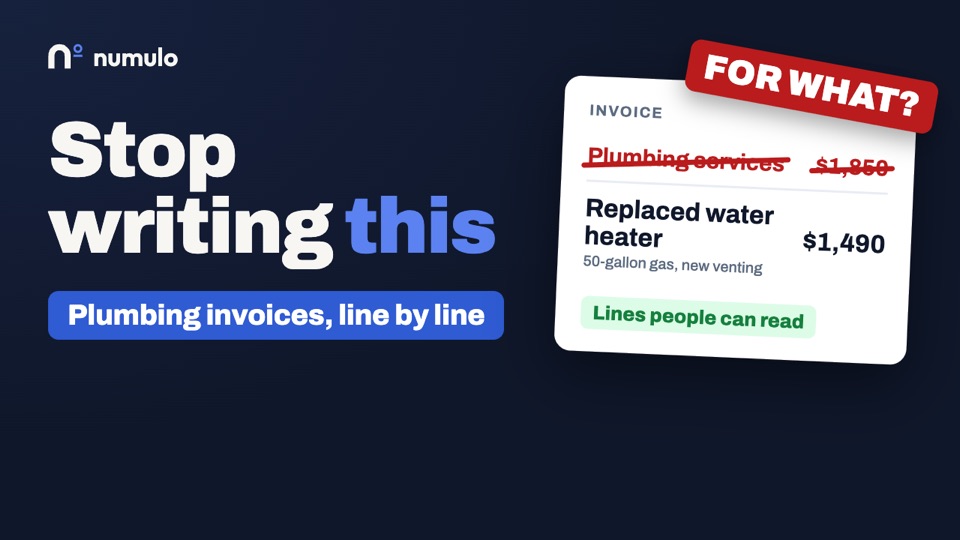
If your invoices say "plumbing services" and a price, you're making it harder to get paid. A vague line makes customers nervous. They can't tell what they got for the money. So they call you to ask. Or they just don't pay yet. Write what you actually did. "Cleared kitchen sink drain." "Replaced 50-gallon gas water heater, new venting." "Installed thermal expansion tank." It takes ten more seconds. Your customer can see where every dollar went. And if they call in eight months saying it's leaking again, you know exactly what you did, and what you didn't.
If you charge a service call fee, put it on its own line. Don't hide it inside your labor. A service call fee covers the trip and the diagnosis. Across the US, it typically runs $75 to $150. When it's a separate line, your customer understands it. You came out. You found the problem. That has a price. When it's buried, your labor just looks high. Some plumbers credit the fee toward the repair if the customer goes ahead. If you do that, show it. One line for the fee, and one line that takes it back off. That's goodwill your customer can actually see.
Next, labor and materials. Keep them apart. Labor is either a flat price for the job, or your hours times your rate. Materials are the major parts, each with a price. You don't need to list every fitting. One line for small parts and supplies is fine. And don't show your markup. Just the price.
For a bigger job, give your customer one clear price, with a breakdown underneath. "Install hot water heater, $1,850." Under it, the heater, and the labor. They see one number, and they see what's in it.
Then the things people forget to bill. The permit and inspection. Hauling away the old unit. If you did it, list it.
If your customer supplied a part, say so on the invoice, and note that it carries no warranty from you.
And if you took photos, keep them with the invoice. The old corroded tank, and the new one installed. Customers like seeing it, and it's a record of how you left things.
Now, sales tax. This depends on your state. In many states, a plumber working on a building pays tax on materials at the supply house, and doesn't add a tax line to the invoice at all. In others, repair work is taxable. We have a separate video that goes through it state by state. Check before you add a tax line.
Put your warranty on the invoice. One line. "Labor is warranted for one year. Equipment carries the manufacturer's warranty." It does two things. It tells your customer you stand behind your work, which is a reason to hire you again. And it sets the limits. Without it, a customer can call you three years later about a part that failed, and expect you to fix it for free. With it, everyone knows what's covered, and for how long. And if this is follow-up work on an earlier job, write the original invoice number on it, so the two are tied together.
At the bottom, say how to pay you. Zelle, Venmo, check, card. Whatever you take. And add a short thank-you. It costs nothing.
Then send it the same day. Before you pull out of the driveway, if you can.
When they pay, send a receipt. It closes out the job for both of you.
We have a free plumber invoice template on our site. Type the job in plain English, and it drafts the line items for you to edit. There's no signup, and no watermark. Head on over to numulo.com. Thanks for watching.
What to Include on a Plumber Invoice
A professional plumbing invoice should clearly list every service performed, parts used, and the labor involved. Include your business name, license number, and contact information at the top. Each line item should describe the specific work done. Avoid vague entries like "plumbing services" and instead write "kitchen sink drain cleaning" or "water heater flush and inspection."
Always include the service date, invoice number, and payment terms. If you charge a service call fee, list it as a separate line item so the customer understands the breakdown. For warranty work or follow-up visits, note the original invoice number for reference.
Common Plumbing Pricing Structures
Most plumbers charge using one of three models:
- Flat rate per job: A fixed price for common tasks like drain cleaning ($150–$300) or faucet replacement ($150–$350). Customers prefer this because there are no surprises.
- Hourly rate plus materials: Typically $85–$150/hour depending on your market, plus the cost of parts. Best for complex or diagnostic work where scope is uncertain.
- Service call fee plus labor: A base fee ($75–$150) just to show up, then hourly or flat-rate pricing on top. This protects you from no-shows and short jobs that still take travel time.
Whichever model you use, be transparent. List parts and materials separately from labor so customers can see exactly what they're paying for.
Not sure where you should sit inside those ranges? What to charge for plumbing jobs in 2026 works through the rate math, parts markup, and when to charge premiums.
Tips for Getting Paid on Time
Cash flow is everything in the plumbing trade. Here's how to avoid chasing payments:
- Invoice immediately. Send the invoice the same day the work is completed, or hand it to the customer before you leave.
- Offer multiple payment methods. Accept credit cards, Venmo, Zelle, and checks. The easier you make it, the faster you get paid.
- Set clear terms. "Net 30" is standard for commercial clients. For residential work, "due on receipt" or "due within 7 days" keeps things simple.
- Follow up. If payment is late, send a polite reminder at 7 days and a firmer one at 14 days. Most late payments aren't malicious. People just forget.
Frequently Asked Questions
What should a plumber put on an invoice?
A plumber's invoice should include your business name and contact info, the customer's name and address, a unique invoice number, the date of service, a description of each service performed, parts and materials used, labor charges, tax (if applicable), the total due, and payment terms. If you're licensed, include your license number for credibility.
How much should a plumber charge for a service call?
Service call fees typically range from $75 to $150, covering your travel time and basic diagnostic work. Some plumbers credit the service call fee toward the repair if the customer approves the work. In high cost-of-living metros, fees can reach $200.
Should plumbers charge tax on labor?
It depends on your state and on the kind of job. In most states, labor to install or repair something that is part of a building is not taxed. The contractor pays sales tax on the materials at the supply house and builds that cost into the price, so there is no separate tax line on the invoice. Several large states differ: New York taxes repair and maintenance work, labor included; Texas taxes repair and remodel work on commercial buildings; North Carolina taxes repair, maintenance and installation services; and Georgia only exempts labor that is stated separately from the parts. Put labor and materials on separate lines, and check your state's revenue department or your accountant before you add a tax line. See our state-by-state sales tax guide for the ten largest states. This is general information, not tax advice.
Is there a free plumber invoice template I can use?
Yes, you're looking at one. Numulo's plumber invoice template drafts your line items from a plain-English description of the job, or you can type your own. Customize the details, then download a clean PDF for free. No signup, no watermarks, no fees.