Do Contractors Charge Sales Tax on Labor? A State-by-State Guide
Written for the person sending the invoice. The rules below cover the ten largest US states plus New Jersey, Washington, Virginia, Arizona and Tennessee, and every one links to the state rule or revenue department page it came from.
Rules checked as of October 2026 · US, by state. Plain-English summary of the published sales tax rules for contractors and service businesses in each state covered, checked against the official pages linked in the guide. Not tax advice. Sources: CDTFA Regulation 1521, Publication 9, Comptroller 94-116, 96-259, Taxable Services, Florida DOR GT-800067.
Read this first. Sales tax on construction and service work is decided state by state, and inside a state it can turn on whether the job improved real property or repaired it, whether the building is a house or a business, and whether you itemized labor separately. Nothing here is tax advice. Use it to ask your accountant a sharper question, and check the linked state page before you change what you charge.
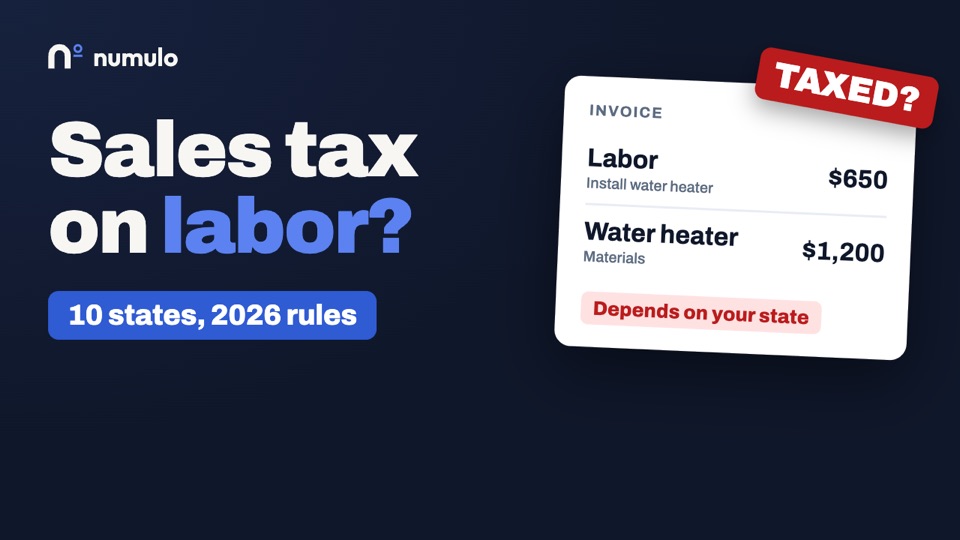 9:08
Play the video: Do Contractors Charge Sales Tax on Labor? 10 States Explained (2026)
Do Contractors Charge Sales Tax on Labor? 10 States Explained (2026) · 9:08. The video plays from YouTube when you press play.
Chapters and transcript
- 0:00 The short answer
- 1:02 The three questions that decide it
- 1:55 California, Texas and Florida
- 3:28 New York and Pennsylvania
- 4:31 Illinois, Ohio and Michigan
- 5:46 Georgia and North Carolina
- 6:54 Five invoice habits that work in every state
- 8:32 Wrap up
Do contractors charge sales tax on labor? In most states, no. If you build, install or repair something that's part of a building, the labor usually isn't taxed. You pay sales tax on your materials when you buy them, and that's the end of it. But four of the ten biggest states have a catch. Texas taxes repair and remodel labor on commercial buildings. New York taxes repair labor. North Carolina taxes repair, maintenance and installation. And Georgia only exempts your labor if it sits on its own line on the invoice. So the real answer is this. It depends on your state, and on how you write the invoice.
I'm going to walk through the ten largest states, one at a time. Then I'll show you five invoice habits that keep you out of trouble in all of them. Everything here comes from each state's own revenue department, and we last checked the rules in September 2026. One thing before we start. This is general information, not tax advice. Use it to ask your accountant a sharper question.
Every state is really answering the same three questions. They just answer them differently.
Question one. Did the work become part of the building? Most states treat a new roof or a built-in water heater very differently from fixing something that stays movable, like a mower or a truck.
Question two. Who is the consumer of the materials? You, or your customer? In most states, when you install materials into a building, you are the end user. You pay tax at the supply house, and you never charge it forward. In a few states, you buy the materials for resale and collect tax from the customer.
Question three. Is your service on the state's taxable list? Some states tax almost no services, and then name a handful anyway. Cleaning, lawn care, pest control and snow removal show up on those lists again and again.
Keep those three questions in mind. Now the states.
California first. You are the consumer of the materials you install. So you pay tax when you buy them, and you don't add tax to your labor. The exception is fixtures. A fixture is something that keeps its own identity after it goes in, like a water heater, a furnace or an air conditioning unit. On those, you're treated as the retailer, and tax applies to the fixture itself. Installation and repair labor on a building is not taxed. Put your installation charge on its own line.
Texas splits on the type of building. Labor to repair or remodel a home is not taxable. Labor and materials to repair or remodel a commercial building are fully taxable. New construction labor is not taxable either way. Texas also taxes what it calls real property services, no matter whose building it is. That means janitorial work, landscaping and lawn maintenance, pest control, and garbage removal. One more Texas detail. With a lump-sum contract, you pay tax on materials when you buy them. With a separated contract, you buy them for resale and collect tax from the customer.
Florida. On a job that improves real property, you are the consumer of the materials. You pay tax at the supply house, and your customer pays none. Listing labor separately doesn't change that. There are two traps. Repairs to things that aren't part of the building, like equipment, unattached appliances and vehicles, are taxable on parts and labor together. And Florida taxes commercial cleaning and commercial pest control. So a cleaning route in office buildings is taxable, and the same work in a house is not.
In New York, everything turns on one question. Is the job a capital improvement, or a repair? A capital improvement adds real value or extends the life of the property, becomes a permanent part of it, and is meant to stay. Building a deck counts. For those jobs, your customer signs form ST-124, you charge no sales tax, and you pay tax on the materials yourself. Anything short of that is a repair, and the whole bill is taxable, labor included. Fixing broken steps is a repair. Swapping a thermostat is a repair. So in New York, the words you use to describe the job really matter.
Pennsylvania. Work that permanently attaches something to real estate is a construction activity, so you don't collect tax on it. Repairing real estate counts too. You pay tax on everything you install, and you're not allowed to show that tax as a line on the invoice. The catch is Pennsylvania's list of taxable services. Building cleaning is on it, homes included, and so is lawn care. We have a separate video just on Pennsylvania.
Illinois doesn't tax services. When you build materials into real estate, you're the end user. You owe tax on what the materials cost you, and you collect nothing from the customer. If you sell an item over the counter without installing it, that's a retail sale, and it's taxable. On repairs to equipment and vehicles, only the parts are taxed. And if your invoice doesn't state a parts price, the tax is figured on half the bill. So state the parts price.
Ohio. You're the consumer of the materials you build into real property, and you pay tax when you buy them. The construction contract itself isn't taxed to the customer. Two exceptions. Equipment that's attached to the building but mainly serves the business inside it is called a business fixture, and installing it is a taxable sale. And Ohio taxes building maintenance and janitorial services, landscaping and lawn care, and snow removal by name.
Michigan taxes goods, and only taxes services where the law names them. When you attach materials to real estate, you're the consumer. You owe the tax on the materials, so nothing goes on the customer's invoice as tax. Parts that leave with the customer in a repair are a retail sale, and those are taxable.
In Georgia, one line on your invoice can make your labor taxable. Here's the rule. On a real property job, you're the consumer of the materials, and you pay the tax when you buy them. Repair and installation labor is exempt. But only when it's stated separately on the invoice. If you bundle labor and parts into a single line, the whole line becomes taxable. Same job. Same price. The only difference is how you wrote it down. One more thing. Fabrication labor, which means making something before it goes in, is taxable either way. So in Georgia, always give labor its own line.
North Carolina is the one that catches people out. The state taxes repair, maintenance and installation services. And installation charges stay taxable even when you separate them on the invoice. A real property contract, meaning a capital improvement, goes the other way. You're the consumer of the materials, and you charge no tax on the contract. A full roof replacement or a major remodel is generally a capital improvement. Fixing a leak or swapping a single fixture is generally a taxable repair. Mixed jobs have to be split up and documented.
So what does all of this mean for the invoice you send tomorrow? Five habits.
One. Put labor and materials on separate lines, every time. In Georgia, it's the difference between exempt labor and taxable labor. In California and Illinois, it decides how the parts are treated. Everywhere else, it costs you nothing.
Two. Say what the work was, not just what it cost. "Replaced the entire roof deck and shingles" and "repaired flashing at the chimney" fall on opposite sides of the line in New York and North Carolina. Your description is your evidence.
Three. Keep the certificates with the job. New York's ST-124. A resale certificate. An exemption certificate for a school or a church. File them against the invoice number, so you can still find them in three years.
Four. Leave off any tax you already paid.
Here's a mistake that shows up on a lot of contractor invoices. A sales tax line for tax you already paid. In most states, when you install materials into a building, you're the consumer of those materials. You paid the tax at the supply house. That tax is now part of your cost, and it belongs inside your material price, the same way fuel does. If you add a separate sales tax line on top, you're telling the state that you collected tax from your customer, and that you owe it to them. So build it into your price, and leave the tax line off.
Five. If you clean, mow or plow, check your state's service list. Cleaning and landscaping businesses in Texas, Pennsylvania, Ohio and Florida are much more likely to owe sales tax than a plumber in the same state.
Here's what that looks like on a real invoice. Labor on one line. Materials on another. A clear description of the work. The tax rate field, only when you really are collecting tax. And a note for the exemption certificate, when there is one.
The full guide is on our site, with a link to every state's own rules. And if you want to build that invoice right now, our invoice generator is free, with no signup. Head on over to numulo.com. Rules change, so check your state's page, or ask your accountant, before you change what you charge. Thanks for watching.
The three questions that decide it
Every state answers the same three questions in its own order. Once you know your state's answers, you know what goes on the invoice.
- Did the work become part of the building? Most states treat a real property improvement completely differently from a repair, and differently again from fixing something that stays movable (a mower, a laptop, a truck).
- Are you the consumer of the materials, or the retailer? In the majority of states a contractor who installs materials into real property is the end user. You pay tax at the supply house and never charge it forward. In others you buy for resale and collect from the customer.
- Is the service itself on the state's taxable list? Some states tax almost no services and then name a handful anyway. Janitorial, lawn care, pest control and snow removal show up on those lists over and over, which catches cleaning and landscaping businesses off guard.
Fifteen states at a glance
"Real property improvement" below means work that becomes a permanent part of the building. "Repair labor" means fixing or maintaining what is already there.
| State | Labor on a real property improvement | Repair & maintenance labor | Who pays tax on materials |
|---|---|---|---|
| California | Not taxed | Not taxed | You, on materials. Fixtures are a retail sale. |
| Texas | Not taxed (new construction) | Taxed on nonresidential, not on residential | Depends on lump-sum vs separated contract |
| Florida | Not taxed | Not taxed on real property | You, at purchase |
| New York | Not taxed (capital improvement, form ST-124) | Taxed, labor included | You on capital improvements, customer on repairs |
| Pennsylvania | Not taxed | Not taxed as construction. Check the service list. | You, at purchase |
| Illinois | Not taxed | Not taxed | You, as end user |
| Ohio | Not taxed | Not taxed on real property. Equipment repair and listed services are. | You, at purchase. Business fixtures differ. |
| Georgia | Not taxed | Not taxed on real property. On equipment, only if separately stated. | You, at purchase |
| North Carolina | Not taxed (real property contract) | Taxed as an RMI service | You on real property contracts |
| Michigan | Not taxed | Not taxed | You, as consumer |
| New Jersey | Not taxed (exempt capital improvement, form ST-8) | Taxed, labor included | You, at purchase |
| Washington | Taxed, labor included | Taxed, labor included | Customer, on the full contract price |
| Virginia | Not taxed | Not taxed on real property. On equipment, only if separately stated. | You, at purchase |
| Arizona | Taxed on new construction (prime contracting on 65% of the price). Not taxed on smaller remodels. | Not taxed on real property. On equipment, only if separately stated. | You on repairs. Built into the 65% on new construction. |
| Tennessee | Not taxed | Not taxed on real property. On equipment and appliances, taxed with labor, even if separately stated. | You, at purchase |
State by state
California
Contractors are consumers of the materials they furnish and install, so you pay tax when you buy them and do not add tax to the customer's labor. You are a retailer of fixtures, the items that keep their own identity after installation, such as water heaters, furnaces and air conditioning units, so tax applies to the fixture itself. Installation and repair labor on real property is not taxed. Separately state your installation charge on the invoice.
Full California guide: labor, materials, fixtures and the jobsite rate →
Source: CDTFA Regulation 1521 and Publication 9.
Texas
Texas splits on the type of building. Labor to repair or remodel residential property is not taxable. Labor and materials to repair, restore or remodel nonresidential property are fully taxable. New construction labor is not taxable either way. Separately, Texas taxes "real property services" no matter whose building it is: janitorial and custodial work, landscaping and lawn maintenance, pest control, garbage removal and surveying. Under a lump-sum contract you pay tax on materials at purchase. Under a separated contract you buy them for resale and collect tax from the customer.
Full Texas guide: residential vs nonresidential, contract types and taxable services →
Source: Comptroller 94-116 and 96-259, Taxable Services.
Florida
On a real property improvement contract the contractor is the consumer of the materials. You pay tax at the supply house and the customer pays none, and itemizing labor separately does not change that either way. Two traps for trades: repairs to tangible personal property (equipment, unattached appliances, vehicles) are taxable on parts and labor together, and Florida names nonresidential cleaning and nonresidential pest control as taxable services, so a commercial janitorial route is taxable while the same work in a house is not.
Full Florida guide: real property vs equipment, fixtures, cleaning and the county surtax →
Source: Florida DOR GT-800067 and Florida sales and use tax.
New York
Everything turns on capital improvement versus repair. A capital improvement substantially adds value or prolongs the life of the property, becomes permanently affixed, and is intended to stay. Get form ST-124 signed by the customer, charge no tax on the job, and pay tax yourself on the materials. Anything that is repair, maintenance or installation short of that test is taxable on the whole bill, labor included, and you buy the materials for resale. Building a deck is a capital improvement. Fixing broken steps or swapping a thermostat is not.
Full New York guide: the capital improvement test, ST-124, material credits and cleaning →
Source: NYS Tax Bulletin ST-104.
Pennsylvania
Work that permanently affixes property to real estate is a construction activity rather than a taxable service, so you do not collect tax on it. Repairing real estate counts as a construction activity too, even when you transfer no materials. You are the ultimate consumer and owe tax on everything you install, and you may not show that tax as a line on the invoice. Pennsylvania does have a list of taxable services, which includes building maintenance and cleaning (residential and commercial) and lawn care. During new construction the rough-stage debris removal is construction labor, but the final clean before the certificate of occupancy is a taxable cleaning service.
Source: 61 Pa. Code § 31.11, § 60.1 and Letter Ruling SUT-08-010.
Illinois
Illinois does not tax services. A contractor who incorporates materials into real estate is the end user of those materials, owes use tax on what they cost, and collects nothing from the customer on the construction contract. Selling an item over the counter without installing it is a retail sale and is taxable. Installation labor agreed on separately from the price of the goods is not taxable. Labor bundled into the selling price of goods rides along with them and is. On repairs to equipment and vehicles only the parts are taxed, and if the invoice does not state a parts price, tax is figured on half the bill.
Source: 86 Ill. Adm. Code 130.1940, 130.450 and 140.106.
Ohio
A contractor who buys materials for incorporation into real property is the consumer and pays sales or use tax on the purchase price, so the construction contract itself is not taxed to the customer. There are two exceptions. Property that is permanently affixed but mainly serves the business run on the premises is a business fixture, stays personal property, and installing it is a taxable sale. And Ohio taxes building cleaning, landscaping and lawn care, pest control, mechanized snow removal and equipment repair by name. Cleaning, lawn care and snow removal are taxed only once your sales of that service pass $5,000 a year.
Source: Ohio Rule 5703-9-14 and Information Release ST 2003-02 on landscaping, lawn care and snow removal.
Georgia
A contractor is deemed the consumer of all tangible personal property used in a real property contract and pays the tax at purchase. The customer pays no sales tax on the contract. When you sell goods that stay movable, or repair equipment and vehicles, installation and repair labor is exempt only when it is separately stated, so give labor its own line every time. Fabrication labor, the work of making something before it goes in, is taxable regardless.
Full Georgia guide: contractors as consumers, separately stated labor, fabrication and local rates →
Source: Georgia DOR contractor FAQs and Rule 560-12-2-.26.
North Carolina
North Carolina is the one that catches people out. The state taxes "repair, maintenance, and installation services" (RMI), and installation charges stay taxable even when you separate them on the invoice. A real property contract, meaning a capital improvement, is treated the other way: you are the consumer of the materials and charge no tax on the contract. A full roof replacement or a substantial remodel is generally a capital improvement. Repairing a leak or swapping a single fixture is generally RMI and taxable. Mixed jobs have to be allocated and documented.
Full North Carolina guide: RMI services, capital improvements, Form E-589CI and county rates →
Source: NCDOR repair, maintenance and installation services.
Michigan
Michigan taxes tangible personal property, and services only where the statute names them. A contractor who affixes materials to real estate is the consumer of those materials and owes sales or use tax on them, so nothing goes on the customer's invoice as tax. Parts that leave with the customer in a repair are a retail sale and are taxable. Straightforward, as long as you remember the tax was already paid on your side and should not be marked as tax on the bill.
Full Michigan guide: contractors as consumers, repair parts, exempt jobs and the flat 6% rate →
Source: RAB 2025-18, the Michigan Treasury construction FAQ and the Contractor Manual.
New Jersey
New Jersey taxes labor more than most states. Repair, maintenance and installation work is taxable at 6.625%, labor included. Labor goes untaxed mainly on an exempt capital improvement, and only once the property owner signs Form ST-8 for you. Even then, landscaping, flooring, alarm systems and permanently affixed signs stay taxable. On every job you pay tax on your materials when you buy them and never show it to the customer as tax.
Full New Jersey guide: capital improvements, Form ST-8, the four taxed improvements and cleaning →
Source: Tax Topic Bulletin S&U-3 and Form ST-8.
Washington
Washington is the opposite of most of this page. Building, remodeling and repairing for a property owner is a retail sale, so the prime contractor charges sales tax on the whole contract price, labor and materials together, at the rate where the job is. Repairing equipment and vehicles and landscaping are taxed on the full charge too. The main exceptions are subcontract work done under the prime contractor's reseller permit and routine janitorial cleaning.
Source: WAC 458-20-170 and RCW 82.04.050.
Virginia
A contractor who builds, repairs or improves real estate is the consumer of the materials, pays tax on them when buying, and puts no sales tax on the customer's invoice. Selling goods that stay movable, or repairing appliances, equipment and vehicles, is different: the parts are taxed and labor is exempt only when it is stated separately. Services such as cleaning and lawn mowing are not taxed. One Virginia quirk: an in-state business charges the rate of its own place of business, not the job site.
Source: Va. Code 58.1-610 and 58.1-609.5.
Arizona
Arizona's transaction privilege tax splits contracting in two. Maintenance, repair, replacement and alterations of existing property under the limits (25% of a home's full cash value, or $750,000 for other property) carry no tax on the job: the contractor pays tax on the materials and the invoice has no tax line. New construction, grading, demolition and bigger alterations are taxed under prime contracting on 65% of the whole contract price, labor included, at the job site's state, county and city contracting rates. Repairs to appliances and vehicles tax the parts, and separately stated labor is exempt. Lawn maintenance and cleaning are not taxed.
Source: A.R.S. 42-5075 and ADOR: MRRA Contracting.
Tennessee
Tennessee taxes goods and a short list of services, and work on real property is not on the list. A contractor who builds, repairs or maintains a building or the land is the user and consumer of the materials, pays tax on them, and may not itemize that tax to the customer. Repairing, installing or cleaning anything that stays movable (freestanding appliances, window units, generators, vehicles, rugs) is taxable on the whole charge, service call and labor included, and listing labor separately does not change that. House cleaning and lawn care are not taxed.
Source: TDOR Sales and Use Tax Manual and TDOR: Sales Tax Issues for Contractors.
What this means for how you write the invoice
- Itemize labor and materials on separate lines, everywhere. In Georgia it is the difference between exempt and taxable labor. In California and Illinois it decides how the parts are treated. In every other state it costs you nothing and makes an audit boring.
- Say what the work was, not just what it cost. "Replaced entire roof deck and shingles" and "repaired flashing at chimney" land on different sides of the capital improvement line in New York and North Carolina. Your invoice description is the evidence.
- Keep the certificates with the job. New York's ST-124, a resale certificate, an exemption certificate for a nonprofit or government job. File them against the invoice number so they are still findable in three years.
- Do not show tax you already paid as a tax line. If you are the consumer of the materials, that tax is part of your cost and belongs inside your marked-up material price. A separate "sales tax" line implies you collected it and owe it to the state.
- Watch the service lists if you clean, mow or plow. Cleaning and landscaping businesses in Texas, Pennsylvania, Ohio and Florida are far more likely to owe tax than a plumber in the same state.
Put the tax on the invoice correctly
The free Numulo editor has a tax rate with a Tax box on every line, so labor and materials can be taxed differently, separate line items for labor and materials, and a notes field for the exemption reference. Fill it in, download a clean PDF, no account needed.
Open the free invoice generator → or start from the contractor invoice template for construction work
Frequently Asked Questions
Do contractors charge sales tax on labor?
In most states, no. Labor to build, install or repair real property is not taxed in California, Florida, Illinois, Michigan, Pennsylvania and Ohio, and the contractor pays tax on materials at purchase instead. There are exceptions: Texas taxes repair and remodel work on nonresidential buildings including the labor, New York taxes repair and maintenance labor that is not a capital improvement, North Carolina taxes repair, maintenance and installation services, New Jersey taxes repair, maintenance and installation labor, Washington taxes the whole contract price, and Georgia only exempts repair and installation labor on goods and equipment when it is separately stated on the invoice.
Should I charge my customer sales tax on materials?
Usually not, if you installed them into real property. Most states treat the contractor as the end consumer of those materials, which means you pay the tax when you buy them and build that cost into your marked-up price. Adding a separate sales tax line on top implies you collected tax you now owe the state. The main exceptions are New York repair work, Texas separated contracts, and any job where you sell an item without installing it.
What is the difference between a capital improvement and a repair?
A capital improvement substantially adds value or prolongs the useful life of the property, becomes permanently affixed to it, and is intended to be permanent. Building a deck, replacing a full roof or adding kitchen cabinets qualifies. Fixing broken steps, replacing a thermostat or repainting existing cabinets does not. New York and North Carolina both hang the tax treatment on this line, so describe the work precisely on the invoice and keep the customer certificate on file.
Do cleaning and landscaping businesses have to charge sales tax?
More often than the trades do. Texas taxes janitorial and custodial services, landscaping and lawn maintenance, and pest control as real property services. Ohio taxes building maintenance and janitorial work, landscaping and lawn care, and snow removal. Pennsylvania taxes building cleaning and lawn care. Florida taxes interior nonresidential cleaning and nonresidential pest control, so a commercial route is taxable while the same work in a house is not. Check your own state's taxable services list before you assume services are untaxed.
Related pages
- California Contractor Sales Tax on Labor, the full state guide
- Texas Contractor Sales Tax on Labor, the full state guide
- Florida Contractor Sales Tax on Labor, the full state guide
- New York Contractor Sales Tax on Labor, the full state guide
- Pennsylvania Contractor Sales Tax on Labor, the full state guide
- Illinois Contractor Sales Tax on Labor, the full state guide
- Ohio Contractor Sales Tax on Labor, the full state guide
- Georgia Contractor Sales Tax on Labor, the full state guide
- North Carolina Contractor Sales Tax on Labor, the full state guide
- Michigan Contractor Sales Tax on Labor, the full state guide
- New Jersey Contractor Sales Tax on Labor, the full state guide
- Washington Contractor Sales Tax on Labor, the full state guide
- Virginia Contractor Sales Tax on Labor, the full state guide
- Arizona Contractor Sales Tax on Labor, the full state guide
- Tennessee Contractor Sales Tax on Labor, the full state guide
- Plumber Invoice Template
- Electrician Invoice Template
- Cleaning Invoice Template
- What to Charge for Plumbing Jobs in 2026
- What to Charge for Cleaning Jobs in 2026
- 2026 Trade Pricing Report, all ten trades on one page
- All free invoice templates