Is Labor Taxable in Pennsylvania? Sales Tax on Contractor Labor
Do Pennsylvania contractors charge sales tax on labor? If you work on real estate, almost never. Pennsylvania moves the tax off your invoice and onto your own material purchases, which is the opposite of what most contractors expect. Watch the list of taxable services: cleaning and lawn care are on it, and plenty of trades do both. Every rule below links to the Pennsylvania Code or the Department of Revenue page it came from.
Rules checked as of September 2026 · Pennsylvania. Plain-English summary of the published sales tax rules for contractors and service businesses in Pennsylvania, checked against the official pages linked in the guide. Not tax advice. Sources: 61 Pa. Code § 31.11, Definitions, 61 Pa. Code § 31.12, Imposition of tax, 61 Pa. Code § 31.5, Persons rendering taxable services, 61 Pa. Code § 60.1, Building maintenance or building cleaning services, Letter Ruling SUT-08-010, Cleaning Services on Houses Under Construction.
Read this first. This is a plain-English summary of the Pennsylvania rules for contractors and service businesses, not tax advice. Pennsylvania decides the answer by asking what happened to the property, so the same crew can run a taxable job and an untaxed job in the same week. Check the linked regulation and ask your accountant before you change what you charge.
 4:53
Play the video: Do Pennsylvania Contractors Charge Sales Tax on Labor? (2026)
Do Pennsylvania Contractors Charge Sales Tax on Labor? (2026) · 4:53. The video plays from YouTube when you press play.
Chapters and transcript
- 0:00 The short answer
- 0:49 What counts as part of the building
- 1:18 The tax you pay, and can't show
- 1:43 When you do charge tax
- 2:11 Cleaning and lawn care
- 3:38 Which rate
- 4:06 How the invoice should look
Do contractors in Pennsylvania charge sales tax on labor? If you work on real estate, almost never. Pennsylvania asks one question. Did you attach something to the building, so it became a permanent part of it? If yes, that's a construction activity. You pay sales tax on your materials at the supply house, and you collect nothing from the customer. And here's what makes Pennsylvania different from New York or Texas. Repairs count too. A plumber fixing a leak. A roofer patching flashing. An electrician replacing a bad breaker. None of that labor is taxable.
That's the simple part. The traps are in what you can't put on the invoice, and in two services that are taxable, cleaning and lawn care. We checked these rules against the Pennsylvania Code in September 2026. This is general information, not tax advice.
The state lists what it presumes becomes part of the building. Built-in dishwashers. Water heaters. Furnaces and central air. Garage door openers, fencing and siding. Cabinets fixed with screws. Carpet that's glued or tacked down. Even trees and shrubs.
And it lists what it presumes stays movable. Window air conditioners. Free-standing appliances. Above-ground pools. Drapes and blinds. Keep that second list in mind, because that's where the tax comes back.
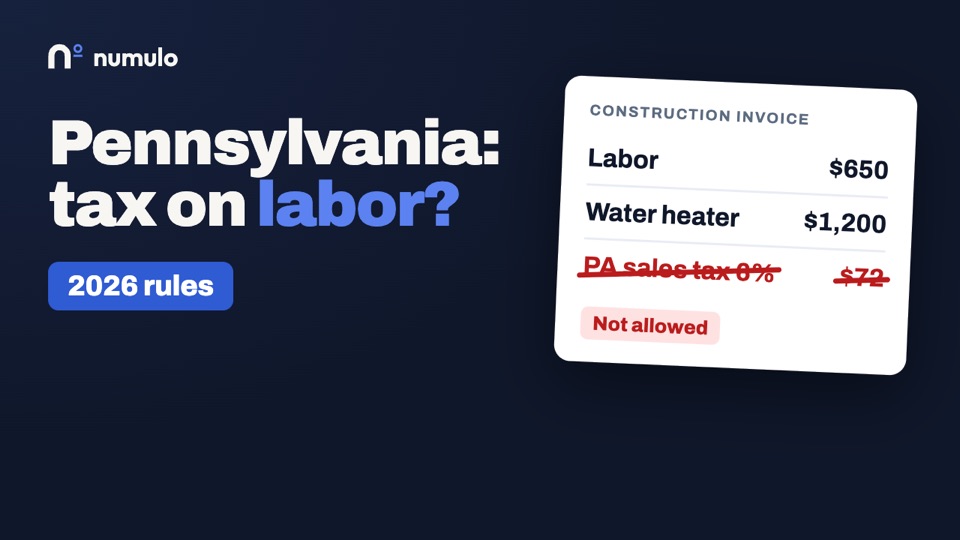
On construction work, you pay tax on everything you install. Materials, equipment and supplies. Now the part that trips people up. You can build that tax into your price. You cannot show it as its own line. A line that says "PA sales tax, 6 percent" on a construction invoice is wrong, even if your costs really did include the tax. Treat it like fuel. It's a cost, and it lives inside your price.
You do charge tax when you sell and install something that stays movable. Then you're a retailer. You need a sales tax license, and you charge tax on the full installed price, with labor and delivery included. The state's own example is a portable dishwasher, billed at $200 installed. The tax is $12, on the whole $200.
The same goes for repairing equipment or vehicles. A mower, an appliance, a truck. Parts and labor are both taxable.
Is house cleaning taxable in Pennsylvania? Yes. Building cleaning has been taxable there since 1991, and homes are not exempt. That covers maid service and housekeeping, janitorial work, window cleaning, carpet cleaning, duct cleaning, and pressure washing a building. A house cleaner in Pennsylvania charges sales tax on the full price of the visit. A house cleaner in Florida doesn't. What isn't taxable? Painting, building repairs, snow plowing and driveway sealing. So if you clean and you also do repairs, put them on separate lines. Mix them together, and the whole invoice can be taxed.
HVAC crews get caught by this too. Cleaning ducts is taxable cleaning. Maintaining the furnace those ducts run off is not. And maintaining central air in an office building is taxable, while the same work in a house is not. So list those on separate lines as well.
If you do lawn care in Pennsylvania, how you write the invoice changes how much tax your customer pays. Mowing, trimming, fertilizing and weed treatment are taxable. Planting or pruning trees, mulching beds, and putting in a brand new lawn are not. But there's a rule. If you don't list the taxable work separately, tax applies to the whole invoice. So picture a spring visit. Mowing, bed mulching and tree pruning. Bill it as one line, and all of it is taxable. Split it into three lines, and only the mowing is.
The rate is simple. 6 percent statewide. 7 percent in Allegheny County. 8 percent in Philadelphia. Nowhere else in the state has a local sales tax.
One wrinkle. For cleaning and lawn care, the local rate follows the county the sale starts in, not the county where the work happens. A cleaning company based in Philadelphia collects 8 percent on a job out in Bucks County. If you work across county lines, that's worth ten minutes with your accountant.
So here's how a Pennsylvania invoice should look. On construction and repair work, no tax line at all. Not zero. Not "included". Nothing.
On cleaning and lawn care, each service on its own line, with tax on the taxable ones.
Describe how the thing was attached. "Installed replacement water heater, hard plumbed" tells a very different story from "delivered and connected a portable washer".
And keep your material receipts. They're your proof that you paid the tax.
The full Pennsylvania guide is on our site, with a link to each regulation. And you can build that invoice for free, with no signup. Head on over to numulo.com. Rules change, so check with your accountant before you change what you charge. Thanks for watching.
The question that decides a Pennsylvania job
Did you attach something to real estate so it became a permanent part of it? If yes, the work is a construction activity. You are the end consumer of the materials, you pay sales tax at the supply house, and you collect nothing from the customer. Repairing real estate counts too: the regulation defines construction activities to include "the service of repairing real estate even though tangible personal property is not transferred by a contractor in conjunction with the repairs which he makes."
That last clause is what separates Pennsylvania from New York and Texas. A plumber who repairs a leak, a roofer who patches flashing and an electrician who replaces a bad breaker are all doing construction activities. There is no capital improvement test to pass and no repair exception to fall into. If it is attached to the building, the labor is not taxable.
The other side of the line is a sales activity: you transfer property that stays movable, or you service somebody's tangible personal property. Then you are a retailer, you register for a sales tax license, and you charge tax on the whole bill including labor and delivery.
The regulation removes most of the guesswork by listing what is presumed permanent and what is presumed not. Built-in dishwashers, water heaters, furnaces, central and wall air conditioners, garage door openers, fencing, in-ground pools, siding, tile and linoleum floor covering, carpet attached by tacking or adhesive, cabinets fixed with screws, trees, shrubbery and landscaping are all presumed to become part of the real estate. Window air conditioners, free-standing appliances, above-ground pools, unattached room-size carpet, drapes, venetian blinds and free-standing cabinets are presumed not to.
Source: 61 Pa. Code § 31.11, Definitions.
What gets taxed, at a glance
| The job | Is the labor taxable? | Who pays tax on materials | On the invoice |
|---|---|---|---|
| Building or remodeling real estate | No | You, at the supply house | No tax line at all |
| Repairing real estate | No | You, at the supply house | No tax line at all |
| Selling and installing something movable | Yes | Customer, through your bill | Tax the full installed price |
| Repairing equipment or a vehicle | Yes | Customer, you buy parts for resale | Tax parts and labor together |
| Building cleaning, houses included | Yes | You, on your supplies | Tax the total charge |
| Mowing, fertilizing, lawn treatment | Yes | Resale on what you apply | Tax the total charge |
| New lawn, planting or removing trees | No | You, at the supply house | No tax line, state it separately |
| Painting, snow plowing, driveway sealing | No | You, at the supply house | No tax line at all |
Construction work: you pay the tax, and it cannot go on the invoice
The rule is one sentence long. "A contractor shall pay tax upon the purchase price of all property, including materials, equipment, components and supplies, which he furnishes and installs in the performance of his construction activities." You pay it to the supplier at the counter. If the supplier is out of state and not registered here, you owe use tax directly to the Department under a use tax number, which is the one prefixed with 89.
You may build that tax into your price, but you may not show it as its own line, and that is what gets contractors in trouble with customers. The Department's own example runs the numbers on a built-in dishwasher: the contractor pays $150 plus $9 tax to the supplier, installs it in a house he is building, charges the customer nothing in tax, and "may include the tax he must pay in his bid proposal but not as a separately stated item." A line reading "PA sales tax 6%" on a construction invoice is wrong even when your cost really did include the tax. Fold it into the price.
Your tools are yours to pay for as well. Backhoes, saws, drills, trucks and anything else you use but do not hand over are taxable to you, and a contract for a public utility does not change that.
When you are a retailer instead
Sell something that stays movable and you switch roles. Get a sales tax license, buy that item on a resale certificate, and charge tax on the full installed price. Labor and delivery ride along: since 1971, "charges for labor or transportation in conjunction with the sale at retail and installation of tangible personal property are subject to tax even though the labor or delivery charges are separately stated on the billing."
The worked example is a portable dishwasher bought for $150 and billed to the customer at $200 including delivery, unpacking and installation. Tax is $12, on the whole $200, not on the $150 of hardware.
A contractor who does both kinds of work needs the sales tax license and has to sort purchases at the counter: resale certificate for what will be resold, tax paid up front on everything else.
Source: 61 Pa. Code § 31.12.
Equipment and vehicle repair is fully taxable
Work on tangible personal property is a taxable service in Pennsylvania whether or not you supply parts. Repairing, altering, mending or cleaning somebody's property is taxable, and so is installing a part in it. Replace a tire and both the tire and the installation charge are taxable. Fit the customer's own spare and the labor is still taxable.
Motor vehicles get named directly: inspecting, altering, cleaning, lubricating, polishing, repairing or waxing them is taxable. Clothing and footwear repair is the notable exemption. Service and maintenance agreements on taxable property are taxable on the entire charge, with no deduction for separately stated items, whatever the agreement is titled.
Source: 61 Pa. Code § 31.5, Persons rendering taxable services.
Cleaning: taxable in Pennsylvania, and houses are not exempt
Since October 1, 1991 building maintenance and building cleaning services performed in Pennsylvania are taxable. Building cleaning covers janitorial, maid and housekeeping work, window cleaning, floor waxing, carpet cleaning, chimney and fireplace cleaning, duct cleaning, light fixture cleaning, indoor pool cleaning, venetian blind cleaning, and the pressure washing of a building. Residential work counts. A house cleaner in Pennsylvania charges sales tax where a house cleaner in Florida does not.
Plenty of adjacent work stays untaxed, and the list is worth pinning above the desk: building repairs, interior painting and wallpapering, exterior painting, sandblasting and pointing bricks, snow plowing, driveway sealing, plumbing repairs such as opening a drain, cleaning outdoor in-ground pools, carpet dyeing, boiler and furnace maintenance since January 1, 1992, and the maintenance or repair of residential air conditioning equipment since July 1, 2000.
Two of those pairings catch HVAC crews out. Cleaning ducts is taxable cleaning, cleaning the furnace they run off is not. Maintaining central air in an office building is taxable, maintaining the same equipment in a house is not.
The office building discount. If you clean the interior of an office building, separately stated employee costs come out of the taxable amount. Wages, benefits, payroll taxes and expense reimbursements can be itemized on the invoice and only the service fee left over is taxed. This only applies to office buildings, meaning buildings where more than 50% of the square footage is used for business, and the Department's example is pointed: an attorney working from a home office that is under half the house pays tax on the full cleaning charge, itemized employee costs and all. Sole proprietors compute the taxable share from last year's Schedule C net profit.
Fire restoration and new construction. On a restoration job, state the cleaning charges and the repair charges separately or the whole invoice is taxable. On a new house, the rough-stage debris removal that keeps the site safe and the trades moving is construction labor and not taxable, while the final clean before the certificate of occupancy is a taxable building cleaning service. The Department drew that line in a 2008 letter ruling, and the boundary is exactly where dumping scrap lumber ends and dusting cabinets begins.
Source: 61 Pa. Code § 60.1, Building maintenance or building cleaning services and Letter Ruling SUT-08-010, Cleaning Services on Houses Under Construction.
Lawn care: mowing is taxable, a new lawn is not
Lawn care services are taxable, and the regulation lists them: fertilizing, mowing, trimming, cutting or edging, dethatching, aerating, watering, liming, raking grass, applying herbicides, insecticides, fungicides or other treatments, and overseeding or sodding an existing lawn. Trimming shrubbery is taxable when it is done alongside other lawn care.
The untaxed column is just as specific: seeding, sodding or plugging to establish a new lawn (and anything done in conjunction with building construction is presumed to be a new lawn), trimming, pruning or fertilizing trees, planting or removing shrubbery and trees, mulching, tilling, weeding or fertilizing shrubbery, flower and vegetable beds, designing lawns and landscapes, and separately stated leaf raking.
Then the sentence that costs people money: "The failure to separately state charges for lawn care services from other nontaxable charges on the same invoice requires the charging of tax on the total invoice amount." Bill a spring visit as one line covering the mow, the bed mulching and the tree pruning, and all of it is taxable. Split it into three lines and only the mow is.
On purchases, you take resale on what you actually apply to the lawn: chemicals, seed, sod, straw, fertilizer, lime. You pay tax on what you use, which means mowers, edgers, aerators, spray applicators, rakes, testing kits and the gas and oil that run the equipment.
Exempt customers: the certificate is yours to hand over, not theirs
Start from the default. On materials that become part of real estate, you cannot borrow your customer's exemption. The regulation says so flatly: a contractor erecting a building, repairing a roof or replacing a door for a government agency, school district, manufacturer or charity "shall pay tax upon the property which he consumes and is not entitled to use the exemption of the ultimate customer."
Act 45 of 1998 carved out the exception that matters on institutional work. Items that qualify as building machinery and equipment, broadly the generation, storage, conditioning and distribution equipment of a building along with its HVAC, electrical, plumbing, communications and alarm systems, can be bought exempt when the project is for a purely public charity, the federal government, the Commonwealth or its instrumentalities, a political subdivision such as a county, city, township or school district, a state university, or a qualified business in a Keystone Opportunity Zone. You claim it by giving your supplier a completed exemption certificate, Form REV-1220, citing the exemption. Everything on the job that is not building machinery and equipment stays taxable to you.
For items that never become part of the real estate and are resold to an exempt customer, the ordinary resale route applies instead, and it needs a sales tax license. A use tax number cannot be used to buy for resale.
Source: 61 Pa. Code § 31.13, Claims for exemptions and PA Department of Revenue, Building Machinery and Equipment.
Which rate, and which county's rate
The state rate is 6%. Allegheny County adds 1% for a combined 7%, and Philadelphia adds 2% for a combined 8%. Nowhere else in Pennsylvania has a local sales tax, which makes this the simplest rate table in the ten largest states.
Where those two extra points apply is less obvious. For a taxable service such as building cleaning or lawn care, the local tax follows the county the sale originates in, not the county the work happens in. A cleaning company based in Philadelphia collects 8% on a job in Bucks County. A Bucks County company cleaning a Philadelphia office collects 6%, and the customer may owe local use tax directly. For construction work, the local tax rides on your purchases: a contractor performing a construction contract in Allegheny County or Philadelphia pays the local tax on the materials and services used or installed under that contract.
Where a sale originates is a judgment call for a business that works across county lines, and it is worth ten minutes with your accountant rather than a guess repeated on every invoice for a year.
Source: 61 Pa. Code § 60.16, Local Sales, Use and Hotel Occupancy Tax and PA Department of Revenue, Sales, Use and Hotel Occupancy Tax.
What this means for how you write the invoice
- On construction work, no tax line. Not zero, not "included", nothing. The tax you paid at the supply house is a cost, so price it into the labor and material lines the way you price fuel.
- Separate the taxable service from everything else. Skipping this is the single most expensive mistake in Pennsylvania. Lawn care mixed with bed work, cleaning mixed with repair, a taxable service bundled with untaxed labor: if the invoice does not split them, the tax applies to the whole invoice.
- Itemize employee costs on office cleaning. If you clean office interiors and you are not separately stating wages, benefits and payroll taxes, you are taxing your own payroll and quoting higher than the crew down the road.
- Describe the attachment, not just the task. "Installed replacement water heater, hard plumbed" and "delivered and connected portable washer" land on opposite sides of the line. Your description is the evidence in an audit.
- Keep the material invoices. On construction work, proof that you paid tax at the supplier is what closes the question. Without it the Department can assess use tax on the same materials.
- File REV-1220 and exemption paperwork against the job. A certificate you cannot produce in three years may as well not exist.
Bill a Pennsylvania job the way Pennsylvania wants it billed
The free Numulo editor gives you a separate line for every service, a tax rate with a Tax box on every line, so labor and materials can be taxed differently, and a notes field for the exemption reference. Fill it in, download a clean PDF, no account needed.
Open the free invoice generator → or start from the cleaning, lawn care or plumber template, or the contractor invoice template for construction work.
Frequently Asked Questions
Do Pennsylvania contractors charge sales tax on labor?
On work performed on real estate, no. Building, remodeling and repairing real estate are construction activities, so you collect no sales tax from the customer and instead pay tax yourself on the materials, equipment and supplies you install. Repair counts as a construction activity in Pennsylvania even when you transfer no materials, which is why a service call to fix a leak carries no tax. You do charge tax when you sell and install something that stays movable, such as a window air conditioner or a free-standing appliance, and when you repair tangible personal property such as a vehicle, a mower or an appliance.
Is house cleaning taxable in Pennsylvania?
Yes. Building cleaning services have been taxable in Pennsylvania since October 1, 1991, and the definition covers janitorial, maid and housekeeping work in a private home just as it covers an office. Only interior office building cleaning gets the deduction for separately stated employee costs, so a residential cleaner taxes the full charge. Snow plowing, interior and exterior painting, building repairs and driveway sealing are not building cleaning services and are not taxable, while pressure washing a building and duct cleaning are.
Can I show sales tax as a line item on a Pennsylvania construction invoice?
No. On a construction contract you are the consumer of the materials, so there is no tax to collect from the customer and none to show. The regulation allows you to include the tax you paid in your bid price but says it may not appear as a separately stated item. If you are also making a retail sale of something that stays movable, that part of the job is a different transaction: it needs a sales tax license, and the tax on it is stated and collected in the normal way.
What sales tax rate do I charge on a Pennsylvania job?
6% statewide, 7% in Allegheny County and 8% in Philadelphia. No other county levies a local sales tax. For a taxable service such as cleaning or lawn care, the local tax follows the county the sale originates in rather than the county the work is performed in, so a Philadelphia-based company can owe 8% on a job outside the city. For construction work the local tax attaches to the materials you buy and use under a contract performed in Allegheny County or Philadelphia.
Related pages
- Sales Tax on Labor by State, the largest states compared
- New York Contractor Sales Tax on Labor, the full New York guide
- California Contractor Sales Tax on Labor, the full California guide
- Texas Contractor Sales Tax on Labor, the full Texas guide
- Florida Contractor Sales Tax on Labor, the full Florida guide
- Illinois Contractor Sales Tax on Labor, the full Illinois guide
- What to Charge for Cleaning Jobs in 2026
- What to Charge for Landscaping Jobs in 2026
- Cleaning Invoice Template
- Lawn Care Invoice Template
- Plumber Invoice Template
- HVAC Invoice Template
- All free invoice templates