House Cleaning Estimate Calculator
How to give an estimate for house cleaning that holds up on the day: work out the labor hours the home needs, then price the hours. Built for cleaning businesses quoting a job.
Send the quote as a proposal the customer signs. The recurring clean as the base, with inside oven, inside fridge and windows as optional items they tick themselves. Typed-name e-signature, and the invoice is created when they accept. Free for 3 proposals a month.
Start a cleaning proposalThe short answer
A standard recurring clean of a US home bills $120–$250 per visit in 2026, a first or deep clean $200–$400, and a move-out clean $250–$500. Where a home lands in each band comes down to labor hours. Square footage sets the base, and bathrooms and the kitchen eat far more time per square foot than bedrooms do. A three-bedroom, two-bath home of about 2,000 square feet is roughly three to four hours for one cleaner on a standard visit and six to eight hours for the first deep clean. Price those hours at what the business bills per cleaner hour, add supplies, and give the customer one flat number. Weekly, biweekly and monthly customers get 10 to 20 percent off the one-time price, since a home cleaned often takes less time. Pets, heavy clutter, extra stories and homes without a professional clean in the past year add 10 to 25 percent, and the quote should say which of those applies.
 5:12
Play the video: How to Price a House Cleaning Job (Free Calculator)
How to Price a House Cleaning Job (Free Calculator) · 5:12. The video plays from YouTube when you press play.
Chapters and transcript
- 0:00 It comes down to hours
- 0:18 Five questions to ask first
- 0:36 How long a home takes
- 1:11 What you bill per hour
- 1:53 The first visit is a deep clean
- 2:49 What adds time
- 3:05 Quote a flat price
- 3:41 Extras as options
- 4:00 Check your number, and put the rules in writing
- 4:47 Wrap up
Pricing a house cleaning job comes down to one thing. How many hours of work is it? Get the hours right, and the price follows. Guess, and you either lose the job, or lose money on it. Here's how to work it out. There's a free calculator you can use on your phone during the walkthrough.
Before you quote, ask five questions. How many bedrooms and bathrooms? Roughly how big is the home? Are there pets? When was it last professionally cleaned? And is there anything you want done that isn't part of a normal clean?
Those five answers give you everything you need to work out the hours.
How long does it take to clean a house? Here's a rule of thumb you can quote from. Start with the size. Allow about one hour of labor for every 600 square feet. Then add for the rooms that take the most work. About 25 minutes for each bathroom. About 10 minutes for each bedroom. So a three-bedroom, two-bath home of 1,800 square feet comes to a little over four hours of labor for a standard clean. With two cleaners, that's about two hours in the house. Multiply those labor hours by what you bill per cleaner hour, add supplies, and that's your price.
What you bill per cleaner hour is not what you pay your cleaner. It has to cover wages, payroll taxes, insurance, travel, supplies and your profit. Across the US, cleaning businesses commonly bill $40 to $75 per cleaner hour. Your area may be different.
Let's run that house. 1,800 square feet. Three bedrooms. Two bathrooms. At $45 a cleaner hour, plus $8 for supplies, it comes to $200 for a one-time standard clean.
Notice that sending two cleaners doesn't change the price. It changes how long you're in the house. The labor hours are the same.
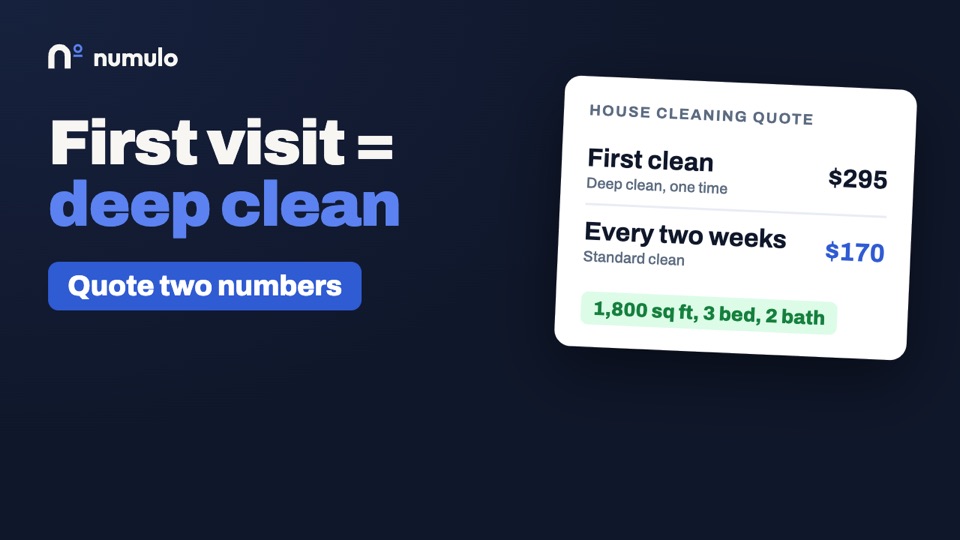
Always price the first visit as a deep clean. Even if the customer wants a regular cleaning every two weeks. The first visit takes about one and a half times as long. You're dealing with build-up that a regular clean never touches. Baseboards. The inside of the microwave. Soap scum that's been there for a year. If you charge your regular price for that first visit, you lose money on day one, and your team starts out behind. So quote two numbers. The first clean, and the regular price after that. Customers understand it. The first visit gets the house to a baseline. The regular visits keep it there.
On our example house, the first deep clean comes to about $295. After that, every two weeks, it's about $170.
The price drops because a home that's cleaned often takes less time. Weekly customers typically get about 20 percent off the one-time price. Every two weeks, 15. Monthly, 10.
Some homes take longer. Pets. Heavy clutter. More than two floors. Or no professional clean in the past year. Add 10 to 25 percent for those, and say why on the quote. Customers accept a higher price much more easily when they can see the reason.
Should a cleaning business charge by the hour, or a flat price? Flat price. Use hours to work out your number, but give your customer one price per visit. Here's why. Customers compare flat prices. An hourly rate just makes them worry about how long you'll take. And hourly pricing punishes you for getting better. If your team gets faster, an hourly job pays you less. With a flat price, you keep that. So figure out the labor hours, multiply by your rate, add supplies, and quote the visit. If the home turns out to be very different from what you were told, quote it again.
Then the extras. Inside the oven. Inside the fridge. Interior windows. Laundry. Don't fold those into your base price. List them as options, each with its own price, and let your customer tick the ones they want.
That keeps your base price competitive. And the customers who want more can add it themselves.
Check your number against the market. As of September 2026, a standard clean of a US home typically bills $120 to $250 a visit. A first or deep clean, $200 to $400. A move-out clean, $250 to $500. If you're far outside those, look again at your hours, or your rate.
And put two things in writing. First, your cancellation policy. For example, 48 hours' notice to reschedule, and same-day cancellations billed at half. Second, for a one-time job on a fixed date, like a move-out clean, a deposit to hold the slot.
Then look at your prices once a year. Wages and supplies go up, and your regulars should hear about a price change in writing, a month ahead.
So. Work out the hours. Price the first visit as a deep clean. Quote a flat price per visit. And offer the extras as options.
The calculator is free on our site. From there, you can turn the quote into a proposal your customer signs on their phone, and set the regular visits to invoice on schedule. Head on over to numulo.com. Thanks for watching.
How the estimate is built
A standard clean runs about one labor hour per 600 square feet, plus roughly 25 minutes per bathroom and 10 minutes per bedroom. Deep cleans and first visits take about one and a half times as long, and move-out cleans closer to one and three quarter times, because of inside appliances, baseboards and built-up grime. Labor hours times your rate per cleaner hour, plus supplies, is the price. Time on site is labor hours divided by the number of cleaners, which is what the customer needs for scheduling.
Quote a flat price, not an hourly rate
Customers compare flat prices, and a flat price rewards your team for getting faster. Use the hours here to set the number, then quote per visit. Always price the first visit as a deep clean: it takes longer, and it sets the baseline that makes the recurring price work.
What changes the number
Pets, heavy clutter, more than two storeys and homes that have not been professionally cleaned in a year all add time. Add 10 to 25 percent and say why on the quote. The cleaning pricing guide has 2026 ranges by home size and clean type to check your result against.
The formula, step by step
- Base labor hours = home size / 600 + bathrooms x 0.4 + bedrooms x 0.15.
- Labor hours = base hours x the type multiplier (standard 1, deep or first visit 1.5, move-in or move-out 1.75) x the frequency multiplier (one time 1, weekly 0.8, every two weeks 0.85, monthly 0.9).
- Time on site = labor hours / cleaners on the job.
- Price per visit = labor hours x rate per cleaner hour + supplies, rounded to the nearest $5. Price per sq ft = price / home size.
At least one cleaner. About 600 sq ft of general cleaning per labor hour, before bathrooms and bedrooms.
Worked example with the starting numbers
Home size (sq ft): 1,800; Bedrooms: 3; Bathrooms: 2; Type of clean: Standard clean; Frequency: One time; Cleaners on the job: 2; Rate per cleaner hour ($): 45; Supplies per visit ($): 8. Result: labor hours 4.3, time on site 2.1 hr, price per visit $200, price per sq ft $0.11.
Typical 2026 US house cleaning prices by home size
| Home | Standard clean | Deep or first clean | Move-out clean |
|---|---|---|---|
| 1 bedroom, 1 bath, under 800 sq ft | $120–$140 | $200–$240 | $250–$300 |
| 2 bedrooms, 1 bath, 800–1,200 sq ft | $120–$170 | $200–$280 | $250–$350 |
| 2 bedrooms, 2 baths, 1,200–1,600 sq ft | $140–$200 | $220–$320 | $280–$400 |
| 3 bedrooms, 2 baths, 1,600–2,200 sq ft | $160–$250 | $250–$400 | $320–$450 |
| Pets, clutter, or no professional clean in a year | Add 10–25% | Add 10–25% | Add 10–25% |
| Weekly, biweekly or monthly schedule | 10–20% off the one-time price | Not discounted | Not discounted |
Typical ranges as of September 2026 · US national. Editorial reference figures for typical US house cleaning work, checked against Numulo's published pricing guide. Sources: Numulo pricing guide, Numulo 2026 trade pricing report.
Use it on a cleaning job
- Cleaning proposal template
- Cleaning estimate template
- Cleaning invoice template
- Cleaning price list template
- What to charge for cleaning work in 2026
Frequently asked questions
How much should I charge to clean a 2,000 square foot house?
A standard recurring clean of a 2,000 square foot, three bedroom, two bath home commonly lands between $160 and $250 in the US, and a first deep clean between $250 and $400. Your local labor cost moves it more than anything else.
Should a cleaning business charge by the hour or by the job?
By the job for recurring residential work. Hourly pricing makes customers watch the clock and penalises an efficient team. Keep hourly for one-off jobs where the scope is genuinely unknown.
How big a discount should recurring customers get?
Ten to twenty percent off the one-time price is typical, with the largest discount for weekly service. The home takes less time when it is cleaned often, so the margin holds.
How long does a first deep clean take compared with a regular visit?
Plan on about one and a half times the hours of a standard visit, and up to double on a home that has gone months without a professional clean. The extra time goes on baseboards, door frames, inside the microwave, built-up soap scum and kitchen grease. Book it as a longer slot so the rest of that day's route does not slide back.
What should a move-out clean include to justify the price?
The empty home cleaned top to bottom: inside every cabinet and drawer, inside the oven and fridge, baseboards, window sills, switch plates and closet shelves. Landlords and property managers check exactly those spots, so list them on the quote. If furniture is still in place or the carpets need shampooing, price those as separate items.
Should I charge more for homes with pets?
Yes, when the pets change the work. Heavy shedding means more vacuuming, hair in upholstery and extra filter changes on your equipment, and litter areas or accidents add time as well. Add 10 to 25 percent depending on how much, and name the reason on the quote so it makes sense when the customer compares your price with another one.