Handyman Estimate Template
The short answer
An insured US handyman bills $50–$100 an hour in 2026, holds small jobs to a minimum of 1.5 to 2 hours, and charges $200–$400 for a half day or $400–$700 for a full day. Flat task prices sit in steady bands: a drywall patch at $150–$300, an interior door installed at $150–$300, a light fixture swap at $75–$150, and a shelf or TV mounting at $50–$100 each. What moves the number is unbilled travel and parts runs, discovery risk behind walls, how many tasks share one trip, and how close the job sits to work that needs a license. Mark materials up 20–40% over cost and list them apart from labor. To find your own rate, add target pay to overhead, divide by about 1,300 billable hours for a solo operator, and add a margin of around 20%.
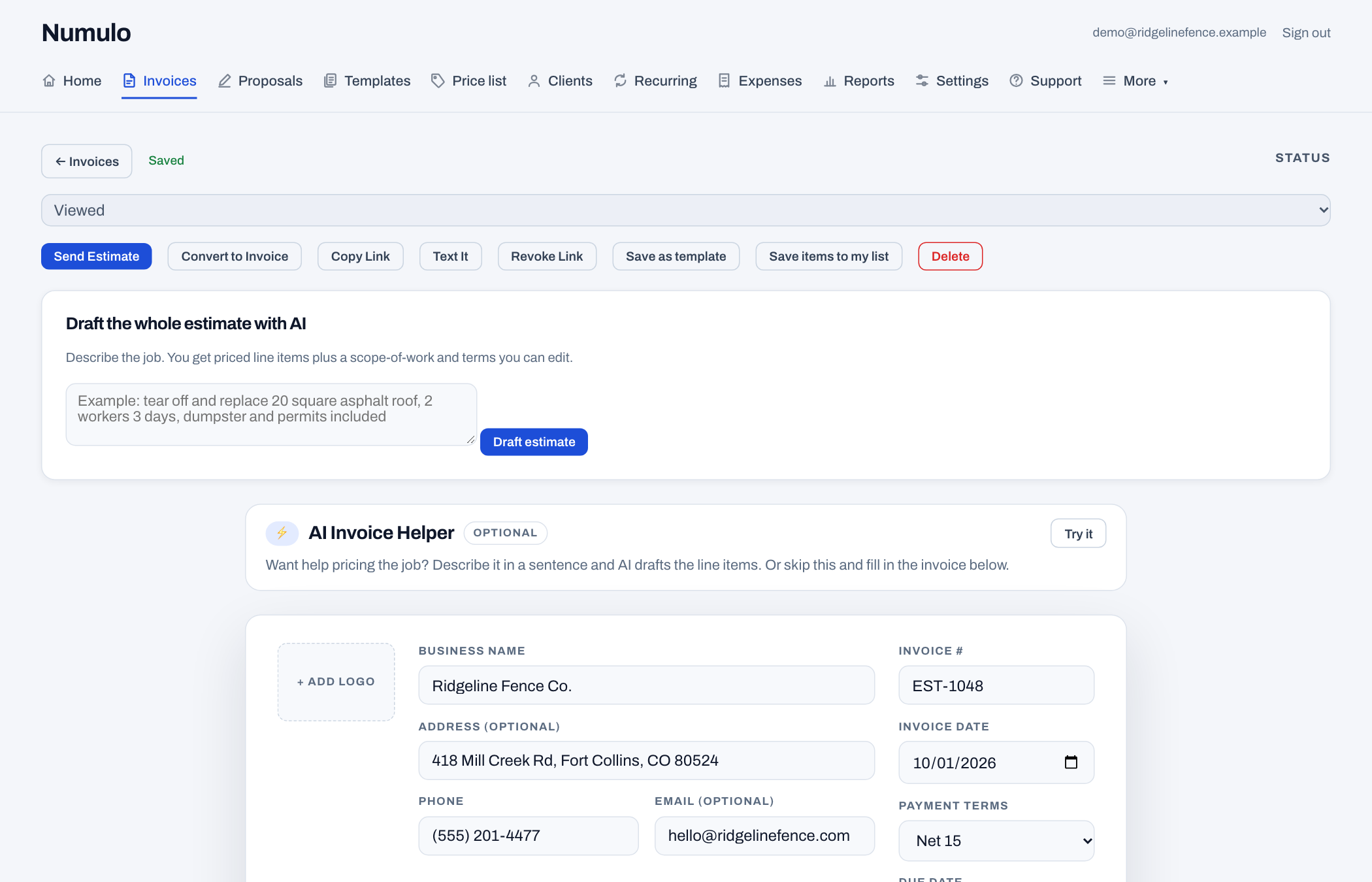
A handyman estimate answers the customer's first question, roughly what will this cost, with enough detail that the answer holds up. Use this template for a quick number with a validity date, send it for online approval, and convert the approved estimate to an invoice with the next number. When the job has options or needs a signature and a deposit, use a proposal instead.
What belongs in a handyman estimate
Handyman proposals bundle a punch list into one priced document. Each task gets its own line with a time or flat price so the customer can prioritise, and the ones they are on the fence about become optional items. Materials are either included in the line or listed as an allowance. Say what you do not do (licensed electrical and plumbing, structural work) and how you handle tasks that run long, because punch lists always grow while you are on site.
Typical handyman prices in 2026
What handyman jobs commonly cost in the US. Your market, your costs and the job in front of you decide your number; use these ranges to check it.
| Job | Typical price | Unit | Usually includes |
|---|---|---|---|
| General handyman labor | $50–$100 | per hour | Insured labor on mixed task lists, materials billed separately |
| Half-day block | $200–$400 | per half day | About four hours on a landlord or property manager punch list |
| Full-day block | $400–$700 | per day | A full working day on site, materials billed separately |
| Drywall patch | $150–$300 | per patch | Cut, patch, tape, mud, texture and prime, ready for paint |
| Interior door installation | $150–$300 | per door | Prehung or slab door fitted, hinges set, latch and strike adjusted |
| Shelf or TV mounting | $50–$100 | per item | Stud-located mount, level install and customer-supplied bracket |
| Light fixture swap | $75–$150 | per fixture | Old fixture removed, new one hung on the existing box |
| Ceiling fan, existing rated box | $100–$200 | per fan | Assembly, mounting and balancing on a fan-rated box already in place |
| Recaulk tub or counter | $50–$100 | per job | Old caulk cut out, surface cleaned, new mildew-resistant bead applied |
| Trip charge, outside service area | $25–$50 | per trip | Extra driving time and fuel beyond your normal radius |
Typical ranges as of September 2026 · US national. Editorial ranges for typical US residential handyman jobs, checked against Numulo's published handyman pricing guide. Sources: Numulo: what to charge for handyman work in 2026, Numulo 2026 trade pricing report.
Sample line items
Realistic 2026 US pricing for a typical job. Every number is editable; optional items are the ones the customer decides on.
| Description | Qty | Rate | Amount |
|---|---|---|---|
| Install 3 ceiling fans in existing fan-rated boxes | 3 | $120.00 | $360.00 |
| Repair drywall, 2 holes, texture and prime | 1 | $240.00 | $240.00 |
| Replace bathroom faucet and supply lines, customer-supplied faucet | 1 | $180.00 | $180.00 |
| Hang 6 interior doors and adjust strikes | 6 | $95.00 | $570.00 |
| Assemble and anchor 2 closet systems optional | 2 | $160.00 | $320.00 |
| Pressure wash and reseal back deck, 300 sq ft optional | 1 | $480.00 | $480.00 |
Required items: $1,350.00. Optional items if all are chosen: $800.00. Rate ranges for this trade are in what to charge for handyman work.
Terms that belong in a handyman estimate
Promise extended coverage on the bid: saying how long you stand behind handyman work separates your number from a cheaper one, and it costs nothing on the day you offer it. Put the terms on the estimate and they carry through to the invoice when the customer approves, then start counting down once that invoice is paid. From there warranty tracking keeps the coverage dates, an estimate of the labor and parts you could still owe, and any callback filed against the job.
Bigger job with options and a deposit? Use the handyman proposal template. Work already done? The handyman invoice template is free too.
Once the work is invoiced, getting paid is handled too: your pay instructions print on the invoice, part payments are tracked, and reminders go out on their own.
How the estimate gets approved
Send the link. The customer sees the items, the total, and the validity date, types their name, and approves. You get an email, and the estimate converts to an invoice with the next invoice number in one click, carrying the same client, items, and any deposit.
Frequently asked questions
What should a handyman charge for a half day or full day?
Half days commonly bill $200–$400 and full days $400–$700. Block pricing suits landlords, realtors and property managers who hand you a punch list across several units. Materials stay on a separate line, and the block covers labor only, so a day spent mostly shopping for parts still leaves you whole.
How do I set a handyman minimum charge?
Make it 1.5 to 2 hours at your hourly rate, so a $75 hourly rate gives a minimum near $150. A 40 minute task still costs you the drive, the parts run and the paperwork. Tell customers the minimum up front and invite them to add small tasks to fill the visit.
Should a handyman charge a trip fee?
Inside your normal service area, fold travel into your rate and your minimum. Outside it, add a stated trip charge of $25–$50 on its own line. Fuel and drive time are real costs, and naming them keeps your base rate competitive for customers close to home.
How much should I charge to mount a TV?
About $50–$100 per TV for a stud-mounted bracket the customer supplies, on drywall at normal height. Brick or tile walls, mounting above a fireplace, or hiding cables in the wall raise it, so list those as separate lines. Any new outlet behind the TV is work for a licensed electrician in many states.
Should a handyman give free estimates?
Quote simple, repeatable jobs free from photos or a phone call, such as a door, a fixture or a drywall patch. When diagnosing the problem is the work, like finding a leak's source or why a floor squeaks, charge your minimum for the visit and credit it toward the repair if the customer hires you.
What is the difference between an estimate and a proposal?
An estimate is a priced list with a validity date that the customer approves with a typed name. A proposal adds a written scope, optional items the customer can pick, terms, an electronic signature record, and automatic invoicing with a deposit on acceptance.
More for handyman jobs
Other trades
Landscaping · HVAC · Plumbing · Electrical · Cleaning · Roofing · Painting · Pressure Washing · Photography · General Contractor